
Here’s How to Use ChatGPT to Create an Outstanding Resume That Gets You Hired
ChatGPT can make a resume clearer, more targeted and much faster to revise. It can also confidently write achievements you never accomplished. The difference between those two outcomes is the way you use it.
Substantially updated August 11, 2026 · A Wandering Mind
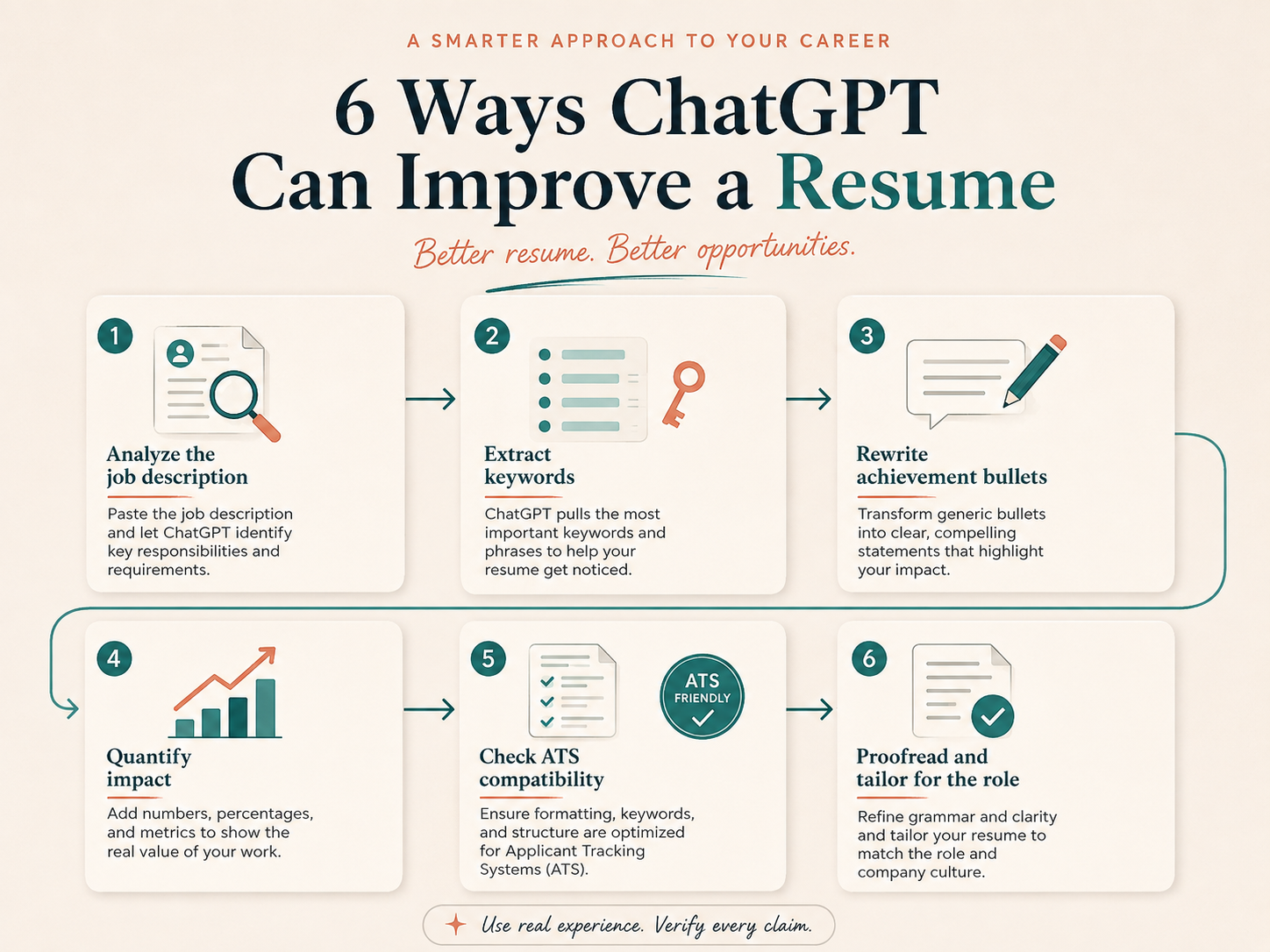
The old way to use ChatGPT for a resume was simple: paste your work history into a chat box and ask it to “make this sound better.” That can still produce nicer sentences. It can also produce the exact kind of resume that experienced recruiters learn to distrust—polished, generic and suspiciously full of accomplishments the candidate cannot explain.
A stronger approach starts somewhere else: your actual experience, the job posting in front of you, and evidence of what you did. ChatGPT becomes the editor, analyst and second set of eyes—not the source of your qualifications.
Give ChatGPT your real resume and the actual job description. Ask it to identify the employer's priorities, map those priorities to experience you genuinely have, strengthen weak wording, and point out missing evidence. Then verify every line before you submit it. The goal is not an “AI resume.” The goal is a more accurate, relevant and readable version of your resume.
AI can improve wording. It should never manufacture responsibilities, credentials, dates or results.
Use the language of the posting where it accurately describes skills and experience you already possess.
Replace vague duties with scale, frequency, outcomes and specific examples whenever you can verify them.
What ChatGPT is actually good at in a job search
ChatGPT is useful because resumes are partly an information problem. You may have ten years of useful experience, but a hiring manager only sees the two pages you decide to send. The challenge is figuring out what matters for this job and expressing it without burying the reader in everything you have ever done.
Current versions of ChatGPT can work with uploaded documents and common file formats, so depending on the features available to your account, you may be able to upload a resume instead of copying every section manually. You can also paste a job description into the conversation and ask ChatGPT to compare the two.
That comparison is where the tool becomes more useful. Instead of asking, “Is my resume good?” ask questions that force a specific analysis:
Have ChatGPT separate required qualifications, preferred qualifications, responsibilities and repeated terminology.
Ask for a direct mapping between the posting and your existing experience rather than a rewritten resume immediately.
Maybe you have leadership experience but never say how many people you supervised. That is a question for you—not permission for the model to guess.
“Responsible for customer service” says what the job required. It does not show what you actually contributed.
ChatGPT can help identify older or less relevant content that may deserve less space.
The three-part rule: truth → relevance → evidence
A good AI-assisted resume can be reduced to three decisions. First, is the claim true? Second, is it relevant to the role? Third, have you given the reader enough evidence to understand its value?
Did you actually do it? Can you explain it clearly if someone asks?
Does this help prove that you can perform the job you are applying for?
Can you show scope, frequency, scale, difficulty, improvement or outcome?
If a bullet fails the first test, delete it. If it passes the first but not the second, consider whether it belongs on this version of the resume. If it passes the first two but feels weak, evidence is probably what it needs.
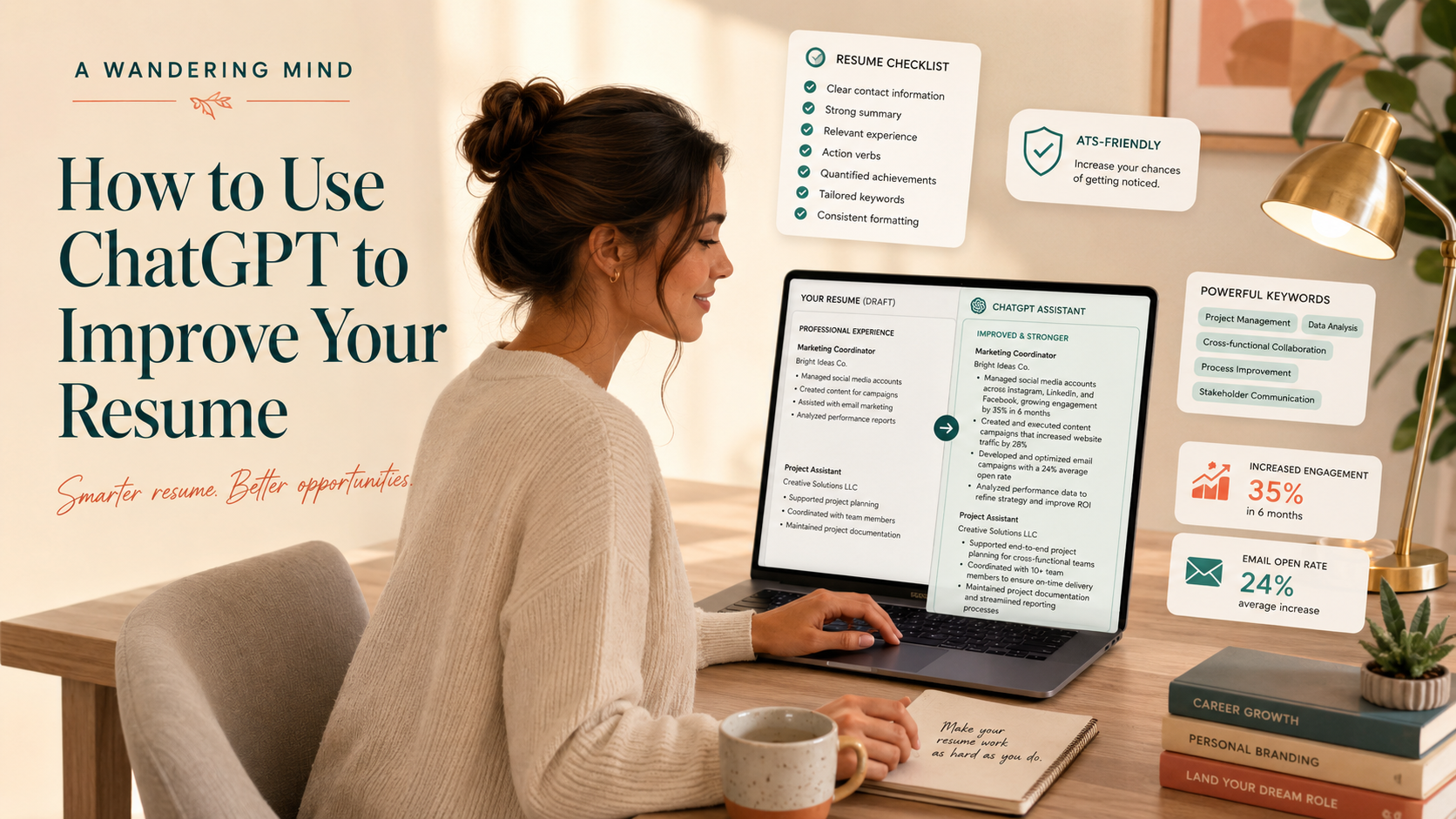
A practical ChatGPT resume workflow
1. Start with a master resume
Keep one version that contains more information than you usually submit: jobs, projects, certifications, software, responsibilities, accomplishments, awards and other potentially useful details. This is your source material.
Your master version does not need to be beautifully optimized for every application. Its job is to make sure useful experience is not forgotten. From there, create a targeted version for each type of role.
2. Give ChatGPT the job posting
Do not begin by asking it to rewrite your resume. First ask it to read the posting like an analyst. Which responsibilities appear repeatedly? Which credentials are mandatory? Which hard skills are named explicitly? Which requirements appear to be the real center of the role?
This is also where keyword matching belongs. Applicant tracking systems vary, but job-specific words and phrases can matter because employers may use software to parse resumes, identify skills and make applications searchable. The safest strategy is not keyword stuffing. It is using the employer's terminology naturally where that terminology accurately describes your experience.
3. Compare the posting with your real resume
Ask ChatGPT to produce a gap analysis. A useful result might say:
Your resume already shows: client relationships and sales.
Your resume does not clearly show: which CRM you used, the frequency of follow-up, whether you met targets, or how you advised customers.
That analysis tells you what questions to answer from memory, sales reports, performance reviews, schedules or other legitimate records.
4. Rewrite one bullet at a time
If you give ChatGPT an entire resume and simply ask for “a better version,” it tends to normalize everything into the same polished tone. Instead, work through the highest-value bullets individually.
A strong prompt includes the original bullet, the real context, any real number you know, and a rule prohibiting invention.
5. Run a final contradiction check
Before submission, ask ChatGPT to compare the final draft against the facts you originally provided. Tell it to flag any sentence that introduces a number, credential, responsibility, tool, title, date or accomplishment that was not in your source material.
That last step is important because a fabricated claim does not become true simply because the model wrote it confidently.
Copy these prompts
These work better than “make my resume better” because each prompt gives ChatGPT a specific job and a clear boundary.
What about applicant tracking systems?
Applicant tracking systems—usually shortened to ATS—help employers organize applications. Their exact behavior differs by system and employer. Some parse your resume into structured fields. Recruiters may search those fields, filter candidates or use criteria connected to the job.
That means there is no universal secret phrase that guarantees your resume reaches a human. A better goal is much less dramatic: make the document easy to read, accurately aligned with the position and easy for software to parse.
| Resume element | Safer approach | What to avoid |
|---|---|---|
| Section headings | Use familiar labels such as Experience, Education, Skills and Certifications. | Creative labels that make the content harder to categorize. |
| Layout | Use a straightforward reading order and simple structure. | Dense text boxes, decorative columns and information hidden in graphics. |
| Keywords | Use terms from the posting when they truthfully describe your experience. | Copying a wall of keywords you cannot support. |
| Skills | Connect important skills to examples in your work history when possible. | A long skill list with no evidence you used them. |
| File format | Follow the employer's instructions. Use a common readable format. | Ignoring an explicitly requested file type. |
| Visual design | Let typography and spacing create hierarchy. | Making the resume depend on photographs, charts or decorative elements. |
Example: improving a car salesperson's resume
Sales jobs are useful examples because the difference between a duty and an achievement is easy to see.
Helped customers choose vehicles and explained financing options.
Nothing is technically wrong with this sentence. The problem is that it could describe almost anyone who worked on a showroom floor.
Guided 40+ customers per month through vehicle selection and financing discussions.
Used needs-based recommendations and structured follow-up to improve the sales process.
Explained how down payment, APR and loan term affected estimated monthly payments.
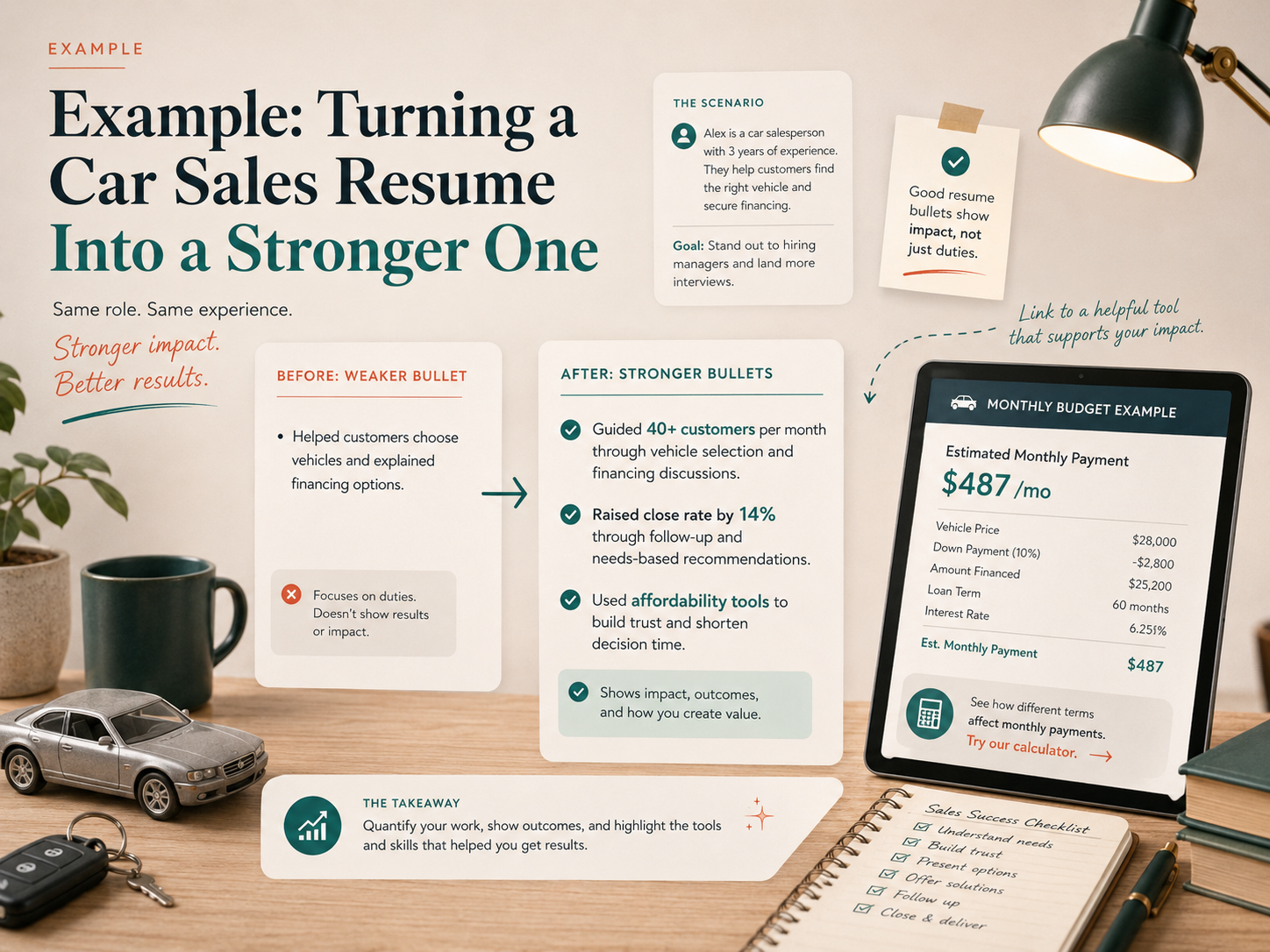
Now consider the tool knowledge behind that last bullet. A salesperson who genuinely understands payment structure, APR, down payments, trade equity and loan terms has a more specific skill than someone who simply says “explained financing.”
A Wandering Mind's Cruising Costs calculator lets you model how vehicle price, down payment, trade equity, APR, taxes, fees and loan term affect the estimated payment and overall borrowing cost. It can be useful for practicing the kinds of affordability conversations automotive professionals have with customers.
Using the calculator does not give you permission to claim dealership experience you do not have. But if payment analysis is already part of your real work, understanding the mechanics can help you describe that skill more precisely.
Open Cruising Costs →How to quantify a resume without making up numbers
“Quantify your resume” is good advice until someone interprets it as “every bullet needs a percentage.” It does not.
Numbers are useful when they reveal scale or context. That might mean revenue, but it could also mean:
Customers served, accounts managed, inventory handled, budget size or territory covered.
Calls per day, reports per week, monthly placements, recurring meetings or scheduled audits.
Cross-functional work, regulatory constraints, multiple locations, deadlines or unusual responsibilities.
Faster turnaround, higher sales, fewer errors, better retention or improved customer experience.
Team size, clients supported, employees trained, departments coordinated or stakeholders served.
Opening/closing, cash handling, hiring, scheduling, reporting, compliance or key customer accounts.
If you cannot recover an exact number, a truthful range may be appropriate when you can support it. If you cannot support even a range, a concrete description can still be stronger than an invented metric.
Do not let AI erase your actual voice
There is a recognizable kind of AI resume. Every bullet begins with a dramatic verb. Everything is “strategic,” “cross-functional,” “results-driven” and “optimized.” Nobody simply trained a new employee; they “spearheaded a transformational onboarding initiative.”
That language is not automatically wrong. It is just often unnecessary.
The best resume usually sounds like a competent person explaining what they did, only more efficiently. If you would feel ridiculous saying the sentence in an interview, revise it.
ChatGPT adds “increased efficiency by 30%” because you asked for a stronger bullet. Delete it unless you supplied that figure.
A posting mentions Salesforce, so the rewrite quietly implies Salesforce experience even though you used another CRM.
The resume repeats every phrase from the posting without showing how you used those skills.
Every bullet becomes longer, more abstract and less believable than the original.
A visually impressive layout makes essential information harder for software or a hurried recruiter to read.
Your strongest evidence for one job may be irrelevant to another. Tailoring should change emphasis, not reality.
What about employment gaps?
The goal is not to invent a story that makes a gap “look better.” First decide whether the gap needs explanation at all. A resume is not required to contain every detail of your life.
If the gap represents something useful and relevant—education, caregiving, independent work, military service, training, volunteering or a project—you may be able to describe that period accurately. If it does not, a concise explanation in a cover letter or interview may be enough.
ChatGPT can help you phrase a truthful explanation. It should not manufacture a consulting business, freelance role or professional-development program that never existed.
Protect information you do not need to share
Before uploading or pasting a resume into any online service, look at the document the way you would look at any file you are about to send to a third party.
- Your full street address if it is not needed for the task.
- Personal reference contact information.
- Employee IDs or internal company identifiers.
- Confidential customer, employer or proprietary information.
- Anything else the model does not need in order to improve the wording.
You can usually replace identifying details with placeholders during the drafting stage and put the real information back into the final document yourself.
Prefer working from a physical resume or interview guide?
Some people think more clearly with a workbook, career guide or printed reference beside them while they revise. You can browse resume, interview and career books through our Amazon Associates link.
Disclosure: A Wandering Mind may earn from qualifying purchases made through this Amazon Associates link, at no additional cost to you. The relationship does not affect the recommendations in this article.
Browse career resources on Amazon →A final checklist before you submit
- The resume is targeted to this specific type of job.
- Every important claim is true.
- Every number can be explained or supported.
- Important skills from the posting appear naturally where you actually used them.
- Major accomplishments describe results, scale or context—not only duties.
- Job titles, companies and dates are correct.
- The formatting is simple enough to read quickly.
- The document uses familiar section headings.
- Spelling, grammar and punctuation have been checked.
- You followed the employer's file-format instructions.
- You removed AI-generated language that does not sound like you.
- You can defend every line in an interview.
Frequently asked questions
Can ChatGPT write my entire resume?
It can help draft and restructure a resume, but the safest workflow is to provide your real background first and review every generated claim. Treat ChatGPT as a writing and analysis tool rather than an authority on what you did in previous jobs.
Can ChatGPT guarantee that my resume passes an ATS?
No. Applicant tracking systems and employer workflows differ. ChatGPT can help you compare a resume with a job posting, identify relevant terminology and simplify formatting, but nobody can honestly guarantee that a particular resume will pass every employer's screening process.
Should I use keywords from the job description?
Yes, when those words accurately describe your qualifications. If the posting asks for project management and you have genuinely managed projects, using that terminology can make the match clearer. Do not add skills simply because they appear in the posting.
Does every resume bullet need a number?
No. Metrics can clarify scale and impact, but a truthful, specific description is better than a fabricated percentage. Numbers should add evidence—not decoration.
Should a resume always be one page?
Not necessarily. Length should follow your relevant experience and the norms of the role. A concise one-page resume can work well for many candidates; experienced candidates may need more room. The important question is whether every section earns its space.
Is using ChatGPT on a resume dishonest?
Using a writing tool to edit, organize or clarify your own experience is different from using it to fabricate qualifications. The ethical boundary is straightforward: the final resume should accurately represent your actual work, skills, education and accomplishments.
Can I upload my existing resume to ChatGPT?
ChatGPT supports working with common document formats and uploaded files on supported plans and surfaces. You can also paste the relevant text directly. Remove unnecessary personal or confidential information before sharing a document with any online service.
The real advantage is not better adjectives
The most useful thing ChatGPT can do for a resume is not replace “helped” with “spearheaded.”
It can force you to look at your own experience from the employer's perspective. What problem did you solve? How often? For whom? With what tools? At what scale? What changed because you were there?
Those questions create better resumes even if you never use artificial intelligence. ChatGPT simply makes the process faster by giving you an endlessly patient editor that can compare documents, reorganize information and keep asking for missing details.
Use that speed. Use the ability to tailor. Use the second set of eyes. But keep the one part the model cannot supply for you: a career history that is actually yours.
Sources & further reading
Share this article
Found this useful? Share it with someone else.