
Gaming Is One of the Greatest Hobbies You Can Pick Up
Grand Theft Auto VI is going to revive an old argument about what video games supposedly do to us. It is worth asking a better question: what have millions of hours spent inside interactive worlds actually taught people?
Long before the technology made sense, a Super Nintendo felt like sorcery.
One of the experiences behind this argument began with a Super Nintendo sent from the United States to Haiti. At the time, the technology was completely unfamiliar.
There was a television, a gray plastic box, a controller and a cartridge. Then there was an entire world happening on the screen because a button had been pressed. There was no understanding yet of processors, software, sprites, circuit boards or game engines. The only useful category available was: magic.
That feeling never completely goes away. Understanding more physics makes it clear that a rocket is not violating the laws of nature when it leaves Earth, and understanding more engineering makes it equally clear that computers are not haunted. Yet watching SpaceX send a Super Heavy booster into the sky, bring it back toward the launch site and catch it with the arms of a tower — something SpaceX first demonstrated in 2024 — can still make some primitive corner of the brain insist: this is witchcraft.
That first console helped cement something much larger than a love of video games. It made technology feel like a place where impossible things could become ordinary. Games became an early way to enjoy figuring out how systems work.
That matters because the best argument for gaming is not that every hour with a controller is secretly homework. It is that games turn curiosity into participation. They give you rules, systems, constraints, feedback, failure and another attempt. Again and again, the player is confronted with some version of the same question:
A movie can show you a journey. A game can make you live inside it.
Gaming can be more compelling than movies, especially when a game has a genuinely good narrative. The Last of Us is one of the clearest examples of why.
A film controls the experience.
The director decides where the camera looks, how long the silence lasts and when the next moment begins. You can empathize with scarcity, danger, grief and attachment, but you remain outside the mechanism.
A game gives you responsibility.
You search the room. You decide whether to use a scarce item. You miss a shot. You repeat an encounter. You physically move the characters through the space between major story beats.
The Last of Us works because its story is not merely delivered in cutscenes. Joel and Ellie's relationship develops while the player is walking with them, searching abandoned places, protecting one another and surviving stretches of quiet between disasters. PlayStation's own description calls their trip a brutal cross-country journey, but the interactive part changes what “journey” means. You spend time doing it.
That time can make narrative attachment feel different. A movie can tell the audience that ammunition is scarce. A game can leave three rounds in an inventory and force a decision about whether the thing standing ahead deserves one of them. A film can show a protector becoming attached to another person. A game can make protection part of the player's routine for hours before asking what that relationship means.
Why interactivity matters to the argument
A good game can combine narrative with repeated decision-making, spatial navigation, resource use and mechanical execution. That does not automatically make it better than a book or film, but it does make it a different kind of medium. The audience is not simply interpreting events; it is operating within a rule system while those events occur.
GTA VI is about to restart a very old fight.
Grand Theft Auto has spent decades being treated as both a video game franchise and a proxy war over what adults should be allowed to simulate for entertainment.
The series is an easy target. GTA lets players steal cars, shoot people, flee police, commit fictional crimes and generally behave in ways that would be intolerable outside a fictional sandbox. GTA VI will also arrive into a media environment where almost every major event can become a culture-war talking point within minutes.
So it is reasonable to expect the old questions to return: Do violent video games make people violent? Are games corrupting children? Are players becoming desensitized? Is spending dozens of hours in Vice City simply wasted time?
The mistake is not asking those questions. The mistake is pretending they all have the same answer — or that any research finding involving the word aggression proves that fictional violence produces murderers.

Evidence box: what the APA actually says
The APA's 2020 reaffirmation described a small association between violent video game use and aggressive outcomes. The same policy material warns against attributing major real-world violence such as mass shootings to violent-game use. That distinction is important enough that this article will preserve it rather than flatten the research into either “games are harmless” or “games cause violence.”
Evidence box: gaming disorder is real — and not the same as playing a lot
The World Health Organization describes gaming disorder around impaired control, increasing priority given to gaming over other activities, and continued or escalating gaming despite negative consequences, with significant impairment in important areas of functioning. WHO says studies suggest only a small proportion of gamers develop the disorder.
The strange thing about “fake” skills is how often pieces of them reappear in real life.
Years before real rounds were sent downrange in the U.S. Army — and before sharpshooter and expert qualification — thousands of hours had already been spent acquiring virtual targets in shooters.
The comparison needs limits. A controller does not teach recoil management, breathing, weapon maintenance, real ballistics or judgment under real consequences. But the basic visual loop — find the target, align the sight, anticipate movement and execute an input — was not unfamiliar.
Thousands of hours of Madden came before the last real snap as a football player. That did not replace practices, coaches or actual contact. It did make football's language and geometry familiar.
A Winthrop University study specifically tested whether Madden could help people learn American football and found evidence that it could increase football knowledge. That is not surprising if you have spent years recognizing formations, positions, downs, field position and situational choices.
Ironclads appeared in Civilization before they appeared in middle-school history class. Their value was already obvious: reaching them before rivals could turn naval warfare into a mismatch, with armored steam-powered ships facing older wooden fleets.
The game was not teaching a complete or neutral history of the world. It was teaching that technologies emerge in sequence, geography changes strategy, resources matter and a military advantage usually exists inside a much larger economic system. Researchers have even used Civilization III as a basis for world-history learning activities.
Before adulthood brought real jobs and real bills, simplified versions of that system had already been practiced repeatedly. There were jobs, bills, houses, expensive goals and characters who somehow ended up millionaires.
The Sims is not a personal-finance course. It is a structured toy economy. But the underlying logic is recognizable: resources are limited, actions consume time, wants compete with needs, improvements require planning, and a long-term goal is often just a chain of smaller decisions.
Research note: action games and attention
A 2018 meta-analysis indexed by PubMed reported that action video game play robustly enhanced top-down attention and spatial cognition, with encouraging evidence for perceptual improvements. That does not mean every action game creates the same benefit or that playing more is always better. It does support the narrower argument that repeated game demands can train specific cognitive processes.
Research note: Civilization as a learning environment
Kurt Squire's work on Civilization III examined what happened when the historical strategy game entered learning environments. The useful takeaway here is not that Civilization is an accurate textbook. It is that an interactive model can provoke questions about geography, resources, development, power and historical change that a learner may then investigate more seriously.
Why invent a completely foreign interface when recruits already know one?
This is one of the strongest answers to the idea that familiarity built through games is useless merely because it began as recreation.
Game controllers are standardized pieces of human-machine interface design. A person who has used them for years already understands two analog sticks, triggers, shoulder buttons, directional pads, thumb buttons and the idea that one hand can control movement while the other controls view or aim.
In 2026, during an Army media roundtable about drone warfare, Col. Nicholas Ryan used almost the exact analogy: the goal of a universal controller is similar to a kid being able to pick up an Xbox or PlayStation controller and use it across different games. That is the point. Familiar interfaces reduce the amount of cognitive overhead spent learning where the buttons are so attention can move to the task.
None of this means Call of Duty is military training. It means the wall between “game interface” and “real interface” is much thinner than critics sometimes assume.
Sometimes a game does not teach the future skill. It teaches you what to notice.
The camera was the mechanic.
Pokémon Snap turned observation into a game loop: look for an animal, watch what it is doing, anticipate a moment, put it in the frame and take the shot before the opportunity disappears.
Looking back at the original Pokémon Snap, the connection to nature photography is almost embarrassingly obvious. The game did not teach aperture, shutter speed, focal length or RAW processing. It did something earlier: it made looking at animals through a camera fun.
Nintendo's description of the original game talks about photographing Pokémon in their “natural habitat,” moving through different environments, and being scored for pose, subject size and whether the Pokémon is centered in the frame. Those are simplified game criteria, not a complete philosophy of photography, but they are recognizably photographic.
The other connection is biology. Pokémon is fictional, but the fantasy is built around organisms: different creatures, environments, traits, forms, habitats and relationships. That makes it remarkably easy for a curious kid to drift from “why does this creature live here?” toward real animals, ecology, variation and eventually evolution by natural selection.
That is a type of educational influence we often miss because it is difficult to measure. A game does not need to deliver a lecture to change what somebody becomes interested in. Sometimes its contribution is simply that years later, standing outside with a camera and waiting for a bird to move into better light feels strangely familiar.

A universe-sized problem-solving machine.
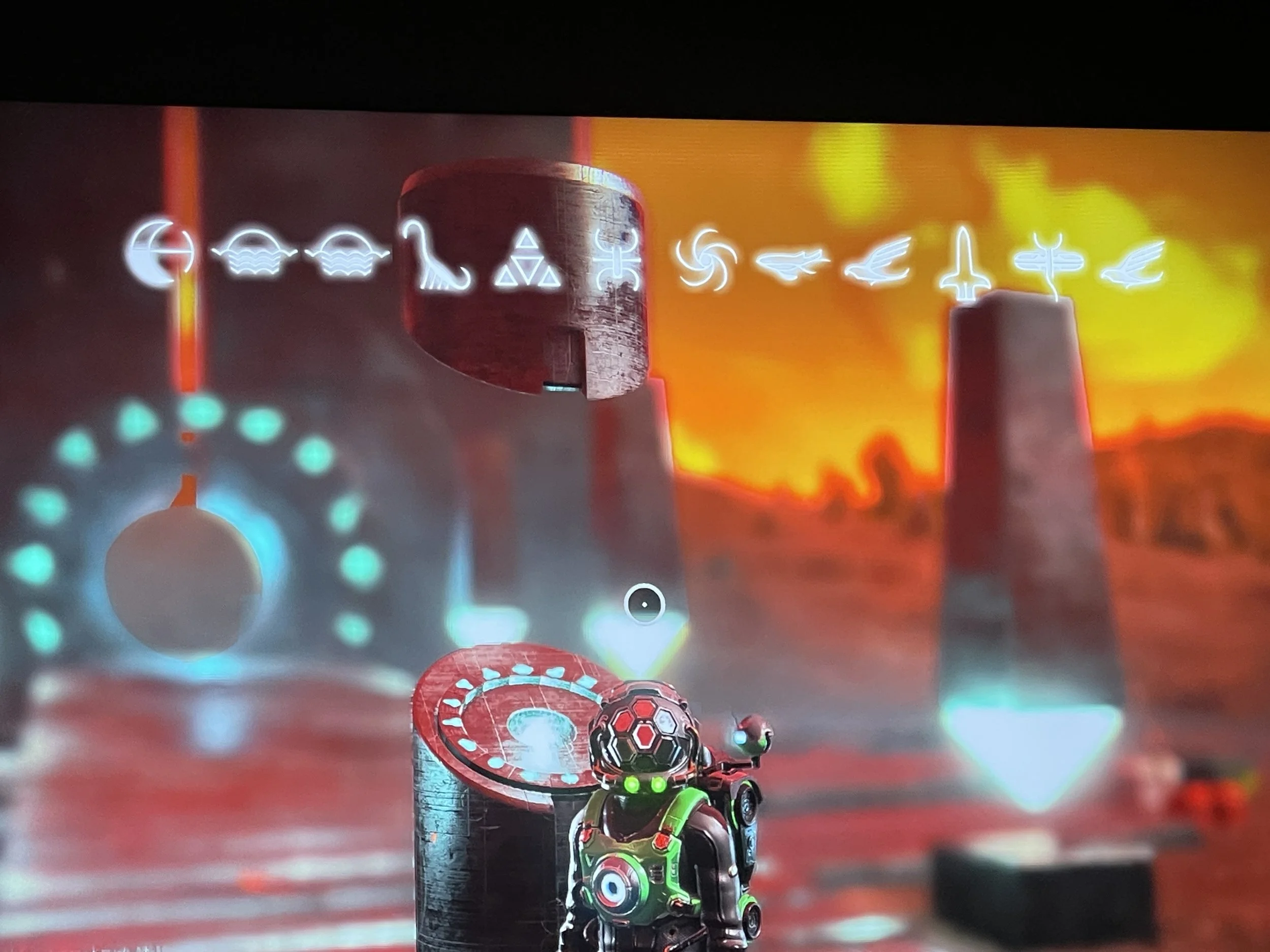
No Man's Sky is one of the clearest examples of gaming as repeated, voluntary problem solving because the game is happy to let the player invent the problem.
Resource management sits underneath almost everything. The player wants to build something, upgrade something, buy something, repair something or travel somewhere. That immediately creates a chain of secondary questions. What materials are required? Which are already available? Where can the rest be found? Is gathering them directly the best use of time, or would earning currency another way and buying them be smarter? That is not a finance class, but it is absolutely a system of tradeoffs, opportunity costs and planning.
Building amplifies the same process. A base begins as an idea and becomes a list of constraints: terrain, power, materials, construction limits, available pieces and the inevitable problem created by something built five minutes earlier. Exploration adds spatial reasoning and curiosity. Expeditions add deadlines and structured objectives. Long saves add an economy. And failure is cheap enough that trying something slightly stupid is often the correct strategy.
That combination is why “grinding” can be enjoyable when the work feeds a system the player cares about. Gathering is tedious when it exists only to delay progress. In No Man's Sky, resources can become a ship, an upgrade, a building, a survival tool or the next stage of a self-created project. The work has somewhere to go.
Break a large goal down.
What has to happen first, what depends on something else and what can be postponed?
Use limited resources.
Time, inventory space, materials, currency and attention are all competing resources.
Try, fail, modify.
The cost of an imperfect attempt is usually low enough to reward experimentation.
Read the full No Man's Sky at 10 retrospective →
Doing something in a fictional system is not the same as endorsing it in real life.
This is where games such as GTA and Cyberpunk 2077 become useful examples instead of embarrassments that need to be explained away.
Stealing a car in GTA does not imply that car theft is acceptable. Building a lethal character in Cyberpunk does not imply approval of Night City's social order. Conquering cities in Civilization does not create an expansionist dictator, and deleting a swimming-pool ladder in The Sims does not require society to convene an ethics panel.
We understand this intuitively with almost every other form of fiction. Enjoying a crime film is not evidence that someone wants to rob a bank. Reading a novel about a murderer is not treated as rehearsal. Games feel different because the player presses the button, and that agency is precisely what makes them interesting. But simulation is still simulation.
Cyberpunk is especially useful here because the game wraps violence inside a world obsessed with corporate power, body modification, inequality, identity, technology and the cost of treating human beings as products. A player can enjoy the shooting and still spend hours thinking about the ideas. Entertainment and reflection are not mutually exclusive.
A defense of gaming gets stronger when it stops pretending games can do no harm.
Gaming disorder is real. WHO includes it in ICD-11 and describes a pattern in which control over gaming becomes impaired, gaming takes priority over other activities, and the behavior continues despite negative consequences serious enough to impair important areas of life.
That should not be minimized. A hobby that crowds out sleep, school, work, relationships, exercise or basic care is no longer functioning as a healthy hobby. But that is not the same as declaring the hobby itself pathological. WHO says gaming disorder affects only a small proportion of people who game.
Time matters less than critics sometimes assume, too. Oxford researchers using direct gameplay data have reported no causal link between time spent gaming and poor mental health in their study, while finding an important difference between people who played because they wanted to and people who felt compelled to play. That distinction fits common sense: six enthusiastic hours on a free Saturday is not psychologically identical to two hours someone feels unable to stop despite wanting to.
Displacement
If gaming consistently replaces sleep, responsibilities, movement or relationships, the cost is real.
Toxicity
Competitive communities can normalize harassment, hostility and behavior that makes social play worse.
Hostile monetization
Loot boxes, pay-to-win systems, manipulative engagement loops and recurring-purchase ecosystems can turn play into extraction.
This last point is important because defending gaming does not require defending every gaming company. A game can be excellent while its monetization is predatory. A hobby can be healthy while a business model built around that hobby is designed to make stopping difficult. Criticizing those systems is not anti-gaming. It is often pro-player.
Why does gaming have to prove that it was useful?
One of the strangest things about the conversation around gaming is how often play is required to submit a résumé.
Someone can watch three hours of football and we generally accept that the purpose was to enjoy football. Someone can watch a film and nobody demands a list of transferable workplace competencies before the credits roll. Reading fiction is culturally respectable even when the reader did not emerge with a new certification.
Gaming is often treated differently. If the player cannot prove that the evening improved reaction time, taught history, strengthened spatial reasoning, increased empathy, developed leadership and somehow added $14.37 to lifetime earning potential, then the time is dismissed as wasted.
That standard is ridiculous.
Rest matters. Play matters. Curiosity matters. Spending time inside an activity you enjoy can be worthwhile without a productivity metric attached to it.
The fact that gaming can also teach is a bonus — a remarkable bonus, sometimes — because it happens inside a medium designed around repeated action. The player learns the rules because understanding the rules helps them do the thing they already wanted to do.
What games actually practice.
The key word is practice, not mastery. A thousand hours of Civilization does not produce a historian. Madden does not produce an NFL coach. Call of Duty does not produce a soldier. Pokémon Snap does not produce a wildlife photographer.
But a thousand hours of interacting with systems is still a thousand hours of interacting with systems. What transfers may be vocabulary, confidence, curiosity, pattern recognition, an interface convention, a mental model or simply the willingness to keep working a problem that did not cooperate the first time.
Questions the GTA VI debate will probably drag back into search.
Do violent video games cause violent crime?
The evidence does not justify treating violent video games as a demonstrated cause of violent crime or mass shootings. Research has found associations with some aggressive outcomes, but the APA explicitly warns against misusing that literature to attribute major real-world violence to games.
Can video games teach real skills?
Yes, but the answer depends on the game and the skill. Research has found effects in areas such as attention and spatial cognition, and specific work has examined learning football concepts through Madden and world-history learning through Civilization III. A game should not be treated as a replacement for professional training or formal education.
Can gaming be addictive?
Yes. Gaming disorder is recognized in ICD-11. The diagnosis concerns impaired control and significant negative consequences, not merely enthusiasm or a high hour count. WHO says only a small proportion of people who game develop the disorder.
Is gaming a waste of time?
Not inherently. Gaming can be recreation, social activity, storytelling, competition, creative expression or skill practice. Like television, sports, reading or other hobbies, its value depends partly on what it adds to a person's life and what it displaces.
Are games better than movies?
That is subjective. Games have a structural advantage in interactivity: the player can participate in a system rather than only observe it. Movies have their own strengths in pacing, direction and control of the viewer's attention. For someone who values agency and participation, narrative games can create a stronger experience.
The technology looked like magic. The games kept offering things to figure out.
Looking backward makes the connections easier to see than they were while they were happening.
Games introduced technologies before their names were familiar. They made football formations familiar before the final real snap. They put ironclads in mind before a history class did. They provided toy economies before adult bills arrived. They turned photographing fictional creatures into a game before wildlife photography became a real interest. They offered stories that could be participated in rather than only watched. They built worlds where failure usually meant one thing: try again.
None of that means games made every later skill possible. Life is not a progression tree and there is no achievement notification when an old hobby quietly becomes useful.
But hindsight makes one thing difficult to dismiss: gaming can have an overwhelmingly positive influence on how someone approaches technology, systems, stories, problems and curiosity — and the experiences behind this article are a strong example of that.
Grand Theft Auto VI will arrive, and some version of the old panic will almost certainly arrive with it. There will be legitimate criticism. There will be bad monetization somewhere else in the industry. There will be people whose gaming becomes unhealthy. There will be arguments worth having about children, age ratings and how much time any of us should spend staring at screens.
Those arguments do not erase everything else the medium can be.
If you have never really played games, you do not need to start with GTA. Find the type of problem you enjoy solving. A story. A city. A farm. A football team. A civilization. A spaceship. A camera pointed at an imaginary animal.
Then press start.
Evidence behind the argument.
- Rockstar Games — Grand Theft Auto VI (current release date, official media and platform information).
- American Psychological Association — Resolution on Violent Video Games.
- APA — 2020 reaffirmation on violent games and aggressive outcomes.
- World Health Organization — Gaming disorder FAQ.
- University of Oxford — gameplay time and mental-health study summary.
- Bediou et al. — meta-analysis of action video games, attention and spatial cognition.
- Jenny & Schary — learning American football through Madden NFL.
- Kurt Squire — learning world history through Civilization III.
- Nintendo — original Pokémon Snap description.
- U.S. Army — robots and Xbox/PlayStation-style controls.
- U.S. Army — 2026 drone-controller roundtable.
- SpaceX — Starship Flight 5 and first Super Heavy tower catch.
- Arthur C. Clarke Foundation — Clarke biography and Third Law.
- PlayStation — The Last of Us Part I.
- A Wandering Mind — No Man's Sky at 10.
- A Wandering Mind — Photography.
- A Wandering Mind — Photography Equipment.
AI disclosure: This article was developed with AI-assisted research and drafting and human review. Personal experiences and opinions reflect the perspective supplied for this article. Research claims should be rechecked during the final pre-publication pass, particularly any current GTA VI release information.
Share this article
Found this useful? Share it with someone else.