
Ladybugs: Biology, Myths, Cultural Meaning & Where They Live
A ladybug crawling across a pair of shorts on Tybee Island became an iPhone photograph—and a reason to look closer at one of the world’s most recognizable beetles: what they really are, what they eat, where they live, why people associate them with luck, and what current insect research is revealing.
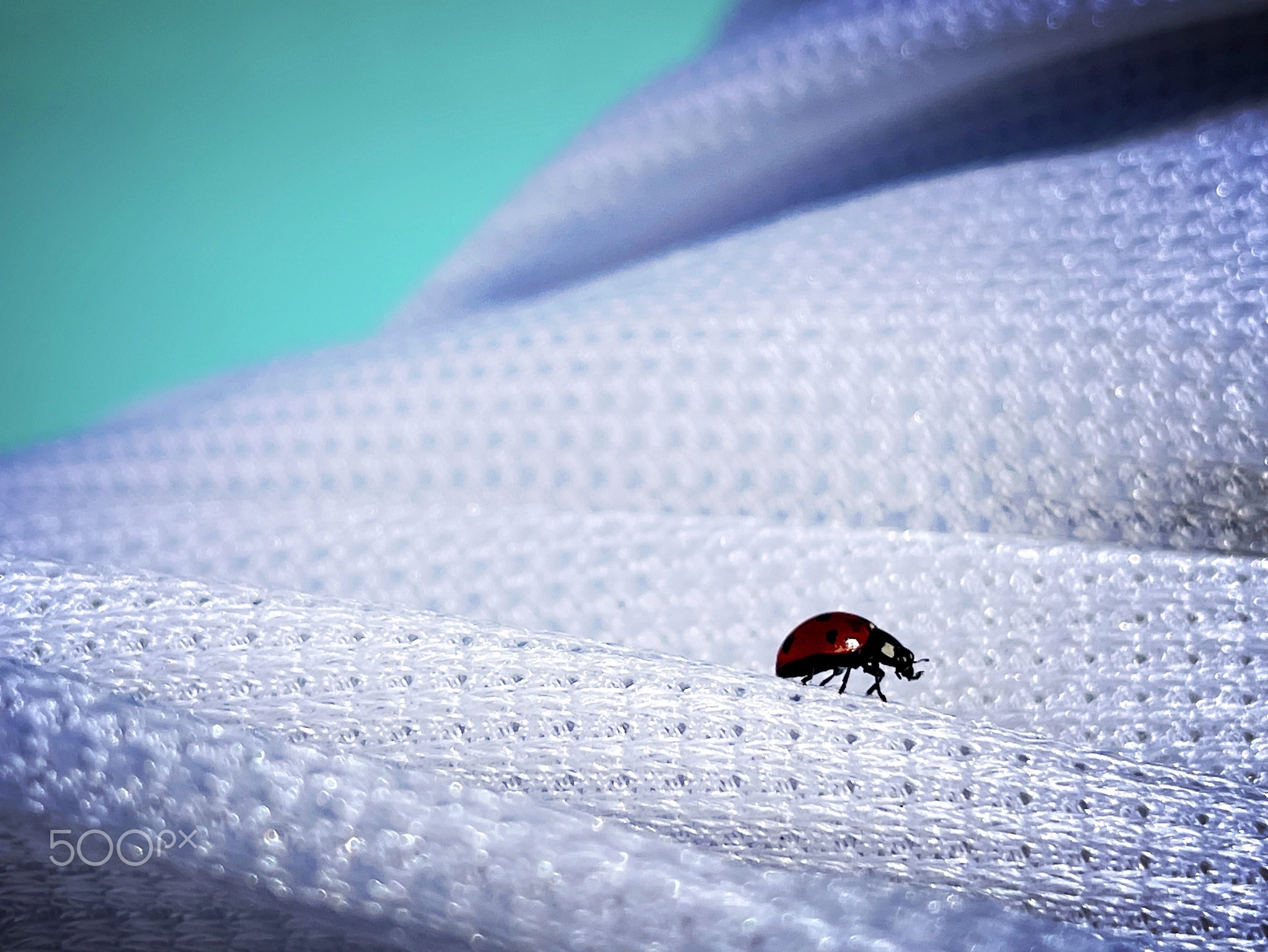
A ladybug is actually a beetle
In North America, “ladybug” is the familiar name. In Britain and much of the English-speaking world, “ladybird” is common. Entomologists often use lady beetle or ladybird beetle because members of Coccinellidae belong to the beetle order Coleoptera, not the order containing the insects scientists call true bugs.
The family is remarkably diverse. USDA Agricultural Research Service material describes roughly 6,000 species worldwide and about 500 in North America north of Mexico. They are not all the textbook red beetle with seven black spots. Lady beetles can be red, orange, yellow, brown or black; some are heavily spotted, some lightly marked, and some nearly spotless.
Their spots do not tell their age
A seven-spotted lady beetle is not seven years old. Spot pattern is associated with species and color form, not birthdays. Some species also vary dramatically from one individual to another. The multicolored Asian lady beetle, Harmonia axyridis, can range from yellow-orange to deep red and from nearly spotless to heavily spotted.
What do ladybugs eat?
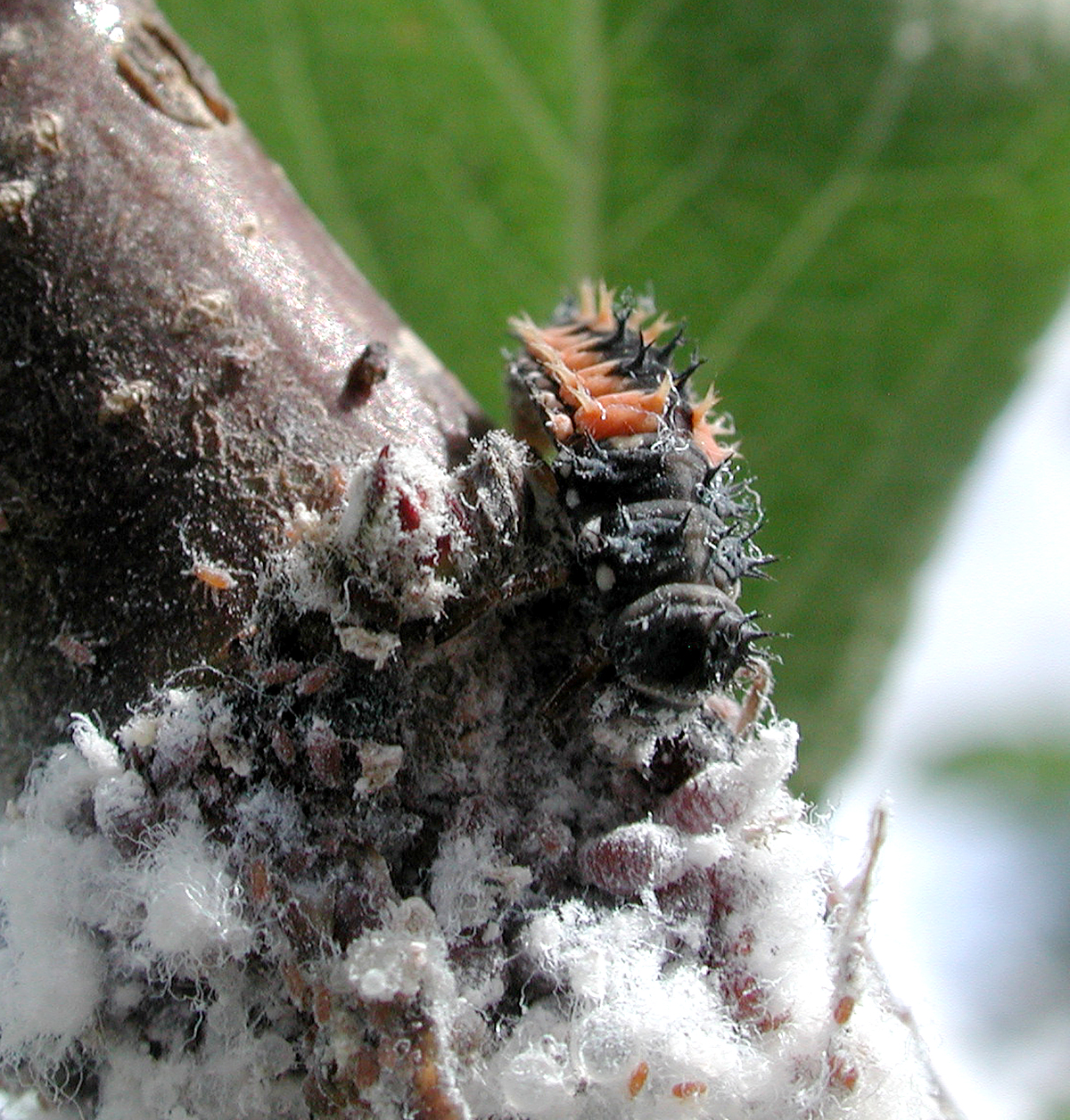
Many familiar lady beetles are predators. Adults and larvae consume aphids, scales, whiteflies, mealybugs, mites and other small prey. That is why gardeners and farmers often welcome them. A lady beetle larva can look surprisingly unlike the rounded adult: elongated, darker, sometimes spiky, and easy to mistake for an entirely different insect.
Six lady beetles that show how different the family can look
The species below are all members of Coccinellidae, but appearance, geography and ecological role differ. The image of the Tybee Island beetle is intentionally left unidentified here; a photograph should not be assigned to species unless the visible features support it.

Seven-spotted lady beetle
Coccinella septempunctataOne of the most familiar red-and-black forms. The seven markings are a species trait—not a record of age.
Aphid predator
Multicolored Asian lady beetle
Harmonia axyridisA highly variable species that may be yellow, orange or red, with few spots or many. It is invasive in many regions outside its native Asian range.
Introduced / invasive in many regions
Convergent lady beetle
Hippodamia convergensA common western North American predator named for the pale lines on the pronotum that angle toward one another.
Western North America
Nine-spotted lady beetle
Coccinella novemnotataA native North American species that became much harder to find across parts of its former range and became a focus of citizen-science searches.
Native conservation focus
Two-spotted lady beetle
Adalia bipunctataAnother species whose familiar name comes from its markings. Its populations have also drawn conservation attention in parts of North America.
Aphid predator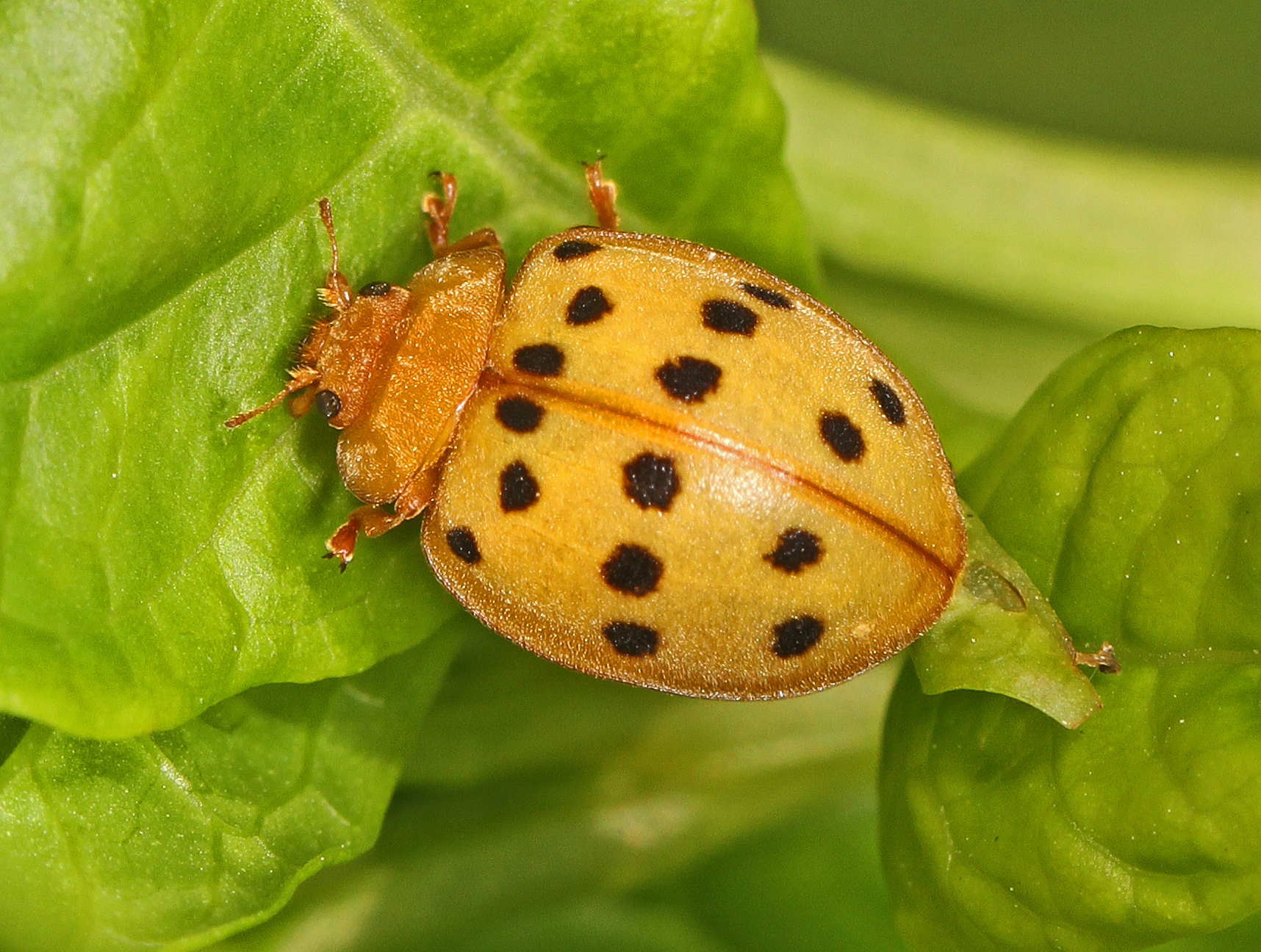
Mexican bean beetle
Epilachna varivestisA useful reminder that “ladybug” does not automatically mean beneficial predator. This species feeds on bean foliage and can be an agricultural pest.
Plant feederWhy are many ladybugs red or orange?
Bright color can function as a warning. Many lady beetles use conspicuous coloration as aposematic signaling: a visual message to predators that the insect may taste unpleasant. When threatened, some species can release yellowish defensive fluid from their leg joints in a behavior often called reflex bleeding.
The cheerful red-and-black pattern humans use on toys, decorations and children's books therefore carries a very different ecological message: eating me may be a bad idea.
Ladybug myths, luck and cultural beliefs
Ladybugs have accumulated unusually positive folklore. This section documents those traditions without treating them as evidence of supernatural effects.
If a ladybug lands on you, will you have good luck?
Do the spots predict years or months of luck?
Where does the “lady” in ladybug come from?
Does harming a ladybug cause bad luck?
Where can you find ladybugs?
Lady beetles occur across much of the world. The useful search question is usually not “which country has ladybugs?” but where are there plants, prey and seasonal conditions that support them? Look on leaves, stems, shrubs and flowering plants, especially where aphids or scale insects are present.
Georgia, Savannah & Tybee Island Southeast
Georgia's long growing season supports abundant vegetation and insect prey. Around Tybee Island and coastal Georgia, look beyond open sand to dune vegetation, gardens, shrubs, trees and other plant-rich areas. Savannah-area yards and parks can also provide habitat.
Florida & the Gulf Coast Southeast
Warm climates can support long periods of insect activity. Gardens, fruit plantings, farms and landscaped parks can all host lady beetles when prey is available.
California West
California has especially high documented lady beetle diversity. UC IPM notes roughly 200 species in the state. The convergent lady beetle is a familiar western species and can form conspicuous seasonal aggregations.
Northeast & Midwest North America
Gardens, farms, meadows, woodland edges and city plantings all offer habitat. This region is also central to efforts to relocate native species such as the nine-spotted and two-spotted lady beetles.
United Kingdom Ladybirds
“Ladybird” is the familiar term. Gardens, parks, trees, shrubs, countryside and leaf litter can host many species. The UK Ladybird Survey accepts public records and photographs.
Almost anywhere plants grow Global
Coccinellidae have a broad global distribution. A similar-looking beetle in Georgia, England, India or Australia should not automatically be assumed to be the same species.
Native species, introduced species and the ladybugs in your house
The multicolored Asian lady beetle, Harmonia axyridis, makes the “good bug/bad bug” label especially complicated. It is an effective predator of plant pests. It is also invasive in many places outside its native Asian range and can compete with native lady beetles.
It is also one of the species people commonly notice gathering around buildings and entering homes while seeking protected overwintering sites. Outside, an individual may be consuming pests. Inside, a large aggregation can become a nuisance. Ecology depends on which species is present, where it is present and what it is interacting with.
What scientists are learning about ladybugs and insects now
Ladybug research is not limited to identification. Current work is exploring sensory biology, biological control, species traits, invasive populations and the long-term history of insect communities.
How a seven-spotted ladybird smells its world
Researchers identified an odorant receptor, CsepOR1, that responds strongly to butyl salicylate. In controlled behavioral tests, different concentrations produced different attraction/repulsion effects and altered predation efficiency—useful evidence for future conservation biological-control research.
Read the PubMed record ↗A modern trait database for UK ladybirds
A Scientific Data project assembled ecological traits, preferences and distribution metrics for 48 ladybird species considered resident in the UK. The dataset is designed to support research on ecosystem roles, environmental change and conservation.
Read the open-access study ↗Ninety years of insect records change the baseline
A Nature Ecology & Evolution analysis used about 1.2 million Swiss records covering 595 saproxylic beetles and 216 butterflies from 1930–2021. It found strong mid-century losses but different later trajectories, highlighting how short modern datasets can hide older declines.
Explore the research ↗You can help researchers with a photograph
A clear photograph can be more than a souvenir. The Lost Ladybug Project has used citizen observations to search for native North American lady beetles that became difficult to find, while the UK Ladybird Survey collects records in Britain.
If identification matters, photograph the beetle from above when possible so the wing-cover pattern and the area immediately behind the head are visible. Preserve the date and general location. And there is usually no reason to handle the insect just to make the image.
A small subject is still wildlife photography
The Tybee Island photograph was made with an iPhone, not a dedicated macro setup. Wildlife photography can begin with a beetle on clothing just as easily as it can with a long lens pointed toward a heron. The common thread is attention.
Want to photograph wildlife?
For readers moving from phone photography into birds and other distant subjects, the wildlife gear guide explains where reach, autofocus and field practicality matter most.
Ladybugs are interesting even when the mythology is not true
You do not have to believe a ladybug predicts good fortune to understand why people have spent generations assigning meaning to them. They are visually distinctive enough to become cultural symbols, useful enough to matter to agriculture, and biologically complicated enough that “helpful little red bug” barely begins to describe the family.
Some native species have become difficult to find. Some introduced species have become extraordinarily successful. Some lady beetles protect plants by hunting aphids; others eat the plants themselves. Researchers are still discovering how they smell, hunt, compete and respond to changing environments.
A ladybug landing on you probably cannot tell you what happens next. But it can still be worth noticing before it continues on its way.
Biology, identification and location sources
Folklore and name-history sources
Current research and citizen science
Image credits and licenses
- Seven-spotted lady beetle: Aiwok, CC BY-SA 3.0.
- Multicolored Asian lady beetle: Gilles San Martin, CC BY-SA 2.0.
- Convergent lady beetle: Eugene Zelenko, CC BY-SA 4.0.
- Nine-spotted lady beetle: Jesse Rorabaugh, CC0.
- Two-spotted lady beetle: Matthieu Sontag, CC BY-SA 3.0.
- Mexican bean beetle: Judy Gallagher, CC BY 2.0.
- Lady beetle larva feeding on aphids: Pollinator, CC BY-SA 3.0.
Each species card links to its Wikimedia Commons description page, where the original file and license terms can be reviewed.
Editorial note: Cultural beliefs are presented as documented folklore rather than scientific claims. Species identification from a photograph should be treated cautiously when diagnostic features are not visible.
Share this article
Found this useful? Share it with someone else.