
Could Shiny Pokémon Survive Natural Selection?
For many players, the red Gyarados at the Lake of Rage was the first time a familiar Pokémon suddenly looked completely different. It was rare, memorable and unmistakable. But imagine that red color was not a programmed collectible mechanic. Imagine it was a naturally occurring, heritable variation in a wild population of Gyarados. Would being red help those Gyarados leave more offspring, hurt their chances, or make no difference at all?
That question gets surprisingly close to real evolution. Not because a Shiny Pokémon is “more evolved,” and not because Pokémon evolution works like biological evolution. It does not. The useful connection is much more basic: natural selection needs variation before it can do anything.
This article sticks to Pokémon introduced in Generations I through III and uses their game mechanics as analogies, not as claims about fictional Pokémon DNA. Shininess is a programmed game property. The games do not establish that a Shiny Pokémon is the result of a real-world-style genetic mutation. That distinction matters, because it lets us use Pokémon to explain natural selection without quietly turning game rules into biology.
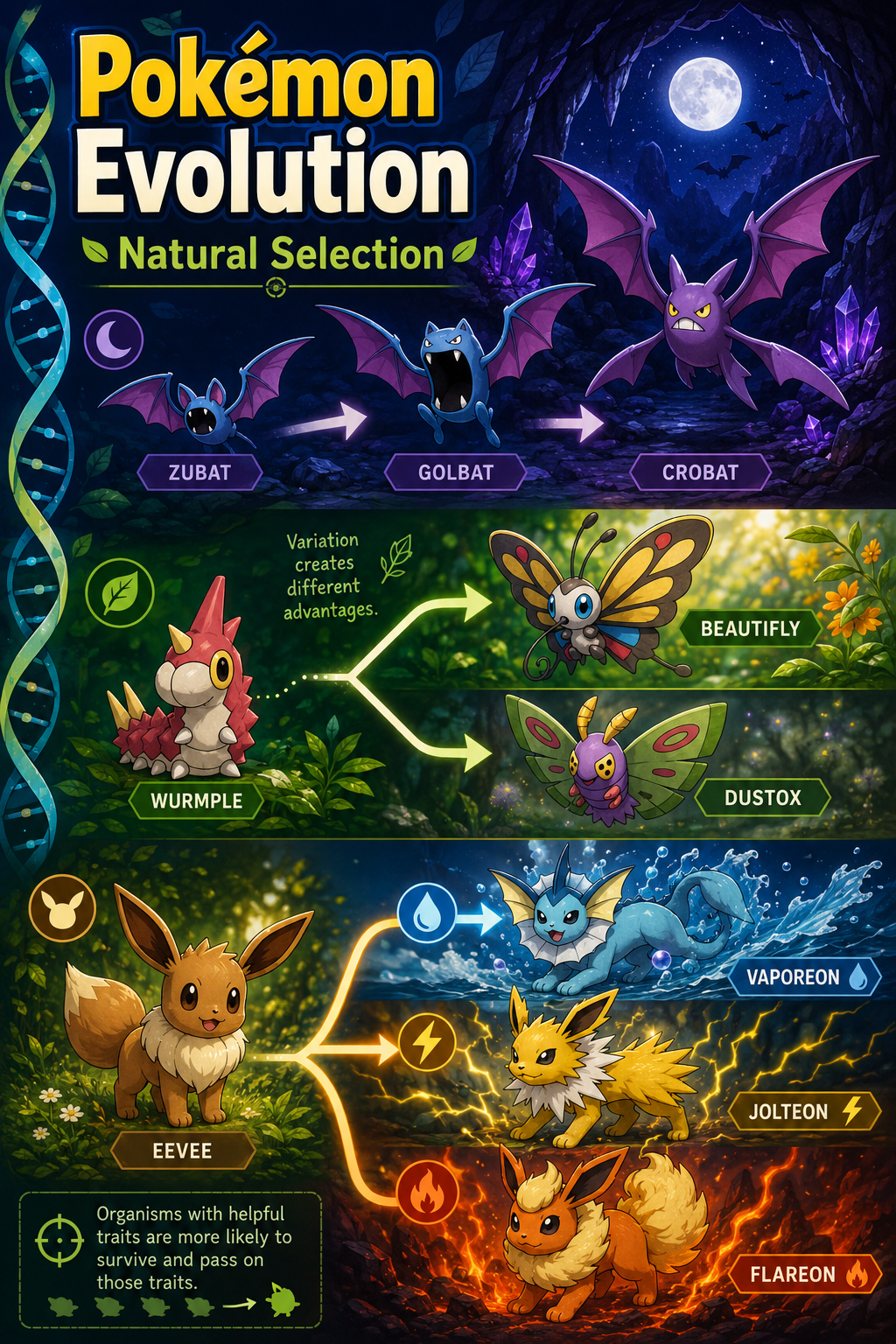
First problem: Pokémon “evolution” is not biological evolution
A Charmander becoming a Charmeleon and then a Charizard is a transformation of one individual during its lifetime. Biological evolution is different. Populations evolve when inherited variants change in frequency across generations. Recent biology-education research has specifically used Pokémon as an example of the common misconception that individuals evolve suddenly rather than populations changing over time.
If we wanted a biological comparison for a Pokémon transformation, development or metamorphosis is usually closer. Caterpie becoming Metapod and then Butterfree is particularly convenient: a real caterpillar becoming a butterfly also undergoes a dramatic change during one organism's life. The butterfly did not biologically evolve when it emerged from the pupa. Its species can evolve across generations; the individual developed.
| Pokémon idea | Closest biology concept | Important difference |
|---|---|---|
| Charmander → Charmeleon → Charizard | Development / life-cycle change | One individual changes form. Biological evolution is measured across populations and generations. |
| Caterpie → Metapod → Butterfree | Metamorphosis | The analogy is visually strong, but it is still an individual life-history process. |
| A rare Shiny color | Phenotypic variation | A rare phenotype can exist without being beneficial, harmful or even heritable. |
| A Shiny trait becomes more common over generations | Potential evolutionary change | This would count only if a heritable basis changed in frequency in a population. |
What natural selection actually needs
Individuals differ. A population cannot be selected into different forms if every individual is identical for the relevant trait.
At least some differences must be inherited. A trait acquired during one lifetime does not automatically become an evolutionary change.
Variants leave different numbers of offspring. In evolution, “fitness” is about reproductive contribution, not gym-style strength.
Frequencies change over time. If one heritable variant repeatedly leaves more descendants, it can become more common.
Mutations are one source of genetic variation. The National Human Genome Research Institute defines a mutation as a change in DNA sequence and notes that mutations in eggs or sperm can be passed to offspring, while mutations in ordinary body cells generally cannot. But mutation alone is not natural selection. A new variant can be helpful, harmful or effectively neutral. Selection begins when heritable differences systematically change reproductive success in a particular environment.
Red Gyarados: rarity is not the same thing as adaptation
The Pokémon Company describes the Lake of Rage as the place where many Trainers probably encountered their first Shiny Pokémon: the famous red Gyarados. In the games, that encounter is special because it is scripted to be Shiny. In nature, however, being rare would tell us almost nothing about whether a color is an adaptation.
A red color could help in one environment, hurt in another, or have no meaningful effect at all. If it made an animal harder for predators to detect—or made prey less likely to notice it—the variant might leave more offspring. If it made the animal more obvious, the same trait might be selected against. If nothing important changed, the trait might remain uncommon for reasons that have little to do with natural selection.
This is why “rare = special = better” is a bad evolutionary rule. Natural selection has no collector's instinct. It does not care whether a phenotype is impressive. It changes frequencies only when the environment, behavior and reproduction make one heritable variant more successful than another.
Shiny Caterpie gives us a camouflage thought experiment
Caterpie is normally green, while its Shiny form is dramatically more yellow-gold. Put those two variants into a hypothetical leafy habitat and we can ask a real evolutionary question: does either color change the odds of surviving long enough to reproduce?
If visual predators consistently detect the gold variant more easily, and if coloration is heritable, the gold-associated variant should tend to decline. Move the same population into a yellow-brown environment and the direction could reverse. The point is not that a real Caterpie would experience exactly this pressure. The point is that fitness is contextual. A trait is not universally good or bad.
Real rock pocket mice provide a remarkably clean version of this scenario. Light-colored mice tend to occur on light substrate, while dark mice are common on dark lava. Research linked dark coloration in one population to mutations in the Mc1r gene, and field patterns support strong habitat-dependent selection for camouflage. The same dark phenotype also evolved through different genetic changes in another lava population. Similar environmental pressure can therefore favor similar outcomes without requiring one predetermined genetic path.
Generation II accidentally gives us a heredity lesson
The original Shiny mechanics are unusually useful for this analogy. In Pokémon Gold, Silver and Crystal, shininess is determined by specific Determinant Values, or DVs—the predecessors of later Individual Values. Because some DVs can be passed through breeding, a parent's values can influence whether an offspring is Shiny. Under the right Generation II breeding setup, the chance of a Shiny offspring can become as high as 1 in 64, dramatically higher than the ordinary 1 in 8,192 base rate.
That is not a model of Mendelian inheritance and there is no “Shiny gene” in the game that maps neatly onto real DNA. But it gives us a useful teaching distinction: a visible variant matters to natural selection only when some underlying cause can be transmitted between generations.
Generation III makes the comparison even better by breaking it. From Ruby and Sapphire onward, shininess is determined from a Pokémon's personality value together with its Trainer ID and Secret ID. Breeding a Shiny parent in Generation III does not give the same inherited-Shiny advantage seen in Generation II. The game mechanic changes, reminding us not to mistake a convenient analogy for fictional biological canon.
Spinda may be the best Gen III lesson about variation
Spinda does not need to be Shiny to make the point. Its face spots vary from individual to individual, and in Generation III those positions are derived from a 32-bit personality value. The games can therefore produce an enormous number of visually distinct Spinda patterns.
That is exactly the population-level perspective we want: stand in front of a crowd of Spinda and variation is obvious before anyone “evolves.” Real populations also contain variation. Much of it may have little or no effect on survival or reproduction. Some of it can matter enormously under particular conditions.
If a hypothetical Spinda spot pattern improved camouflage, mate attraction, temperature regulation or some other heritable component of reproductive success, natural selection could change how common the underlying variant became. If the spots did nothing consequential, their frequency could still change through other evolutionary mechanisms.
Not every rare trait is selected: genetic drift matters too
Natural selection is only one mechanism of evolution. Mutation introduces new variation. Gene flow moves variants between populations. And genetic drift can change allele frequencies simply through chance, especially in small populations.
Imagine a tiny island population with five Shiny-colored Pokémon among one hundred individuals. Suppose color has absolutely no effect on reproduction. By chance, several of those five might leave many offspring—or none might. The trait could become more common or disappear without ever being an adaptation. The National Human Genome Research Institute defines genetic drift as random fluctuation in allele frequency and notes that it can cause a rare variant to become common, disappear or even become fixed.
That gives us another important correction to the usual story. Evolution is not automatically improvement. A population can evolve because selection favors a trait, because variants move between populations, or because random sampling changes frequencies. Natural selection is the mechanism that produces adaptive fit to an environment; it is not the only way populations change.
Shiny Survival Lab: what if the color really changed fitness?
The model below asks a deliberately simplified question. Start with a rare “Shiny” variant, give it a small reproductive advantage or disadvantage, and watch what happens to its frequency across generations.
Set the population
Model limits: this is a teaching model, not Pokémon game math and not a full population-genetics simulation. It treats the visible variant as if it maps directly to one inherited factor, uses a simple directional-selection equation, and excludes diploidy, dominance, mutation, migration, genetic drift, changing environments and population-size effects.
The important part is the direction. Give the variant a persistent advantage and it can move from rare to common. Give it a disadvantage and selection pushes it downward. Set the fitness effect to zero and this deterministic model holds the frequency steady—while a real finite population could still wander because of genetic drift.
If a formerly rare color became dominant throughout a real population, calling it “the rare color” would eventually stop making sense. That is a fun way to see the difference between game rarity and biological frequency. Pokémon can permanently label an individual Shiny. Nature has no such metadata flag.
So would a Shiny Pokémon survive natural selection?
There is no single answer. A Shiny Pokémon could be favored, selected against or effectively ignored by natural selection depending on what its variation actually does in its environment—and whether that difference is heritable.
If the variant helps its carriers leave more offspring, its underlying heritable basis can increase in frequency.
If the variant lowers reproductive success, selection can make it rarer and may eventually remove it from the population.
If the difference has little effect on fitness, its frequency may be shaped more by drift, migration and mutation than selection.
The same color can help in one habitat and hurt in another. Fitness belongs to a trait-environment relationship, not to the trait alone.

What Pokémon gets wrong—and what it accidentally gets right
Pokémon uses the word “evolution” for an individual transformation that biology would describe very differently. That can reinforce the misconception that organisms evolve because they grow, train, need to improve or reach a more powerful stage. Real evolution has no required ladder and no guaranteed endpoint.
But the games also give us a world packed with visible individual variation, inheritance systems, breeding, environmental differences and populations. Shiny Pokémon are useful precisely because they are not automatically stronger. They force us to ask the right question: not “Is this rare?” but “Does this heritable difference change reproductive success here?”
That is the heart of natural selection. Variation exists. Some of it is inherited. Environments make some differences matter more than others. Across generations, those differences can reshape a population.
Frequently asked questions
Are Shiny Pokémon mutations?
The games do not establish a real-world biological mechanism that makes shininess a DNA mutation. Shininess is a programmed game property. In this article it is used as an analogy for visible variation. A real mutation is a change in DNA sequence; only heritable genetic changes can be transmitted through reproduction.
Is Pokémon evolution the same as real evolution?
No. Pokémon evolution transforms one individual during its lifetime. Biological evolution is population-level change in inherited variation across generations. Development or metamorphosis is often a closer analogy for what happens to an individual Pokémon.
Would a Shiny Pokémon be more fit?
Not simply because it is Shiny. Evolutionary fitness means reproductive contribution to the next generation. A color variant could increase, decrease or have no meaningful effect on fitness depending on the environment.
Why is Generation II especially useful for this analogy?
In Generation II, shininess depends on specific DVs, and breeding can pass some relevant DVs from parents to offspring. That creates a heredity-like relationship. It is still a game mechanic rather than a biological genetic model, and Generation III changes the shininess calculation.
Can evolution happen without natural selection?
Yes. Allele frequencies can also change through genetic drift, mutation and gene flow. Natural selection is distinctive because it systematically connects heritable variation with differences in reproductive success.
Sources and further reading
- The Pokémon Company International, “Remember the Region: Johto Spotlight” — official description of the Lake of Rage and red Gyarados. Read the official Pokémon article.
- Bulbapedia, “Shiny Pokémon” and “Pokémon breeding” — Generation II/III shininess and breeding mechanics. Shiny Pokémon reference.
- Green, Delgado and colleagues, “Popular media and the bombardment of evolution misconceptions,” Evolution: Education and Outreach — research on recurring evolution misconceptions, including Pokémon. Read the paper.
- National Human Genome Research Institute, genetics glossary entries for mutation, evolution, genomic variation and genetic drift. NHGRI genetics glossary.
- HHMI BioInteractive, “Natural Selection and Adaptation” — rock pocket mouse teaching resources and population-genetics materials. Explore the HHMI resource.
- Nachman, Hoekstra and D'Agostino, “The genetic basis of adaptive melanism in pocket mice,” Proceedings of the National Academy of Sciences 100(9), 2003. Read the primary study.
- Bulbapedia, “Spinda” and “Personality value” — Generation III spot-pattern mechanics. Spinda reference.
Editorial note: Pokémon mechanics are used here as a teaching analogy. Where the article discusses hypothetical camouflage or reproductive effects, those scenarios are explicitly fictional thought experiments, not claims about canon Pokémon ecology.
Pokémon, Pokémon character names and related trademarks are the property of their respective owners. A Wandering Mind is not affiliated with, endorsed by, or sponsored by Nintendo, Creatures Inc., GAME FREAK inc., The Pokémon Company or The Pokémon Company International. This independent article discusses game mechanics for commentary and educational purposes.